


Learning to Trust the Process
- jayanthi chesetti
- Mar 24
- 4 min read

I came across an Art2Life advertisement about a 25-day Bloom Challenge. Like most art tutorials and workshops I stumble upon, I blindly signed up and then forgot about it. I happened to come across it again in my email, clicked on it, and Nick talked about the Bloom practice — the idea of feeling your emotions and just painting without worrying about the outcome.
I was already late to the challenge and was watching the replays. The comments echoed my own thoughts: what if you don't know what you're feeling? Nick said to just put paint on the paper and play around — put something down, and if you don't like it, cover it up.
It was the first time in a while that I simply painted without worrying about the outcome, whether I could sell it, none of those thoughts. I wasn't completely free, but it was a start. The second day I took out more of my art supplies, tried playing around, and felt much freer than day one.
It had been a long time since I painted freely without worrying whether the art would be good enough to use as a design, or whether it was accurate or realistic enough — and after every session, I felt at peace. I continued for a few days but then stopped.
So when I came across the Creative Visionary Workshop, it felt like the right next step — and I signed up. With my previous experience from the Bloom Challenge, it was easier to get into it, even if I didn't exactly know what I wanted.
The workshop ran over several days, each with a different theme or focus. Here's how each day went for me.
Day 1
This was just an introduction, and Nick taught us about the Bloom practice again. Painting along with them was fun, and watching the way they freely played around helped me not overthink things and just paint. Someone mentioned you could also just write anything, so I thought, why not? I don't usually do lettering or include writing in my artwork, so it felt different — but I didn't want to overthink it and just went for it.

Day 2
Nick talked about shapes, and admittedly I wasn't thinking too deeply about it. One of the guests used scrap paper to make her artwork, and that gave me the idea to use the tissue paper I had been using to wipe my paint off. It had interesting colors and patterns, and I wanted to incorporate it — so I just went ahead. This painting is something fairly random — as I was painting, I noticed I had ended up with two distinct environments, so I just went with that concept and see where it took me.

Day 3
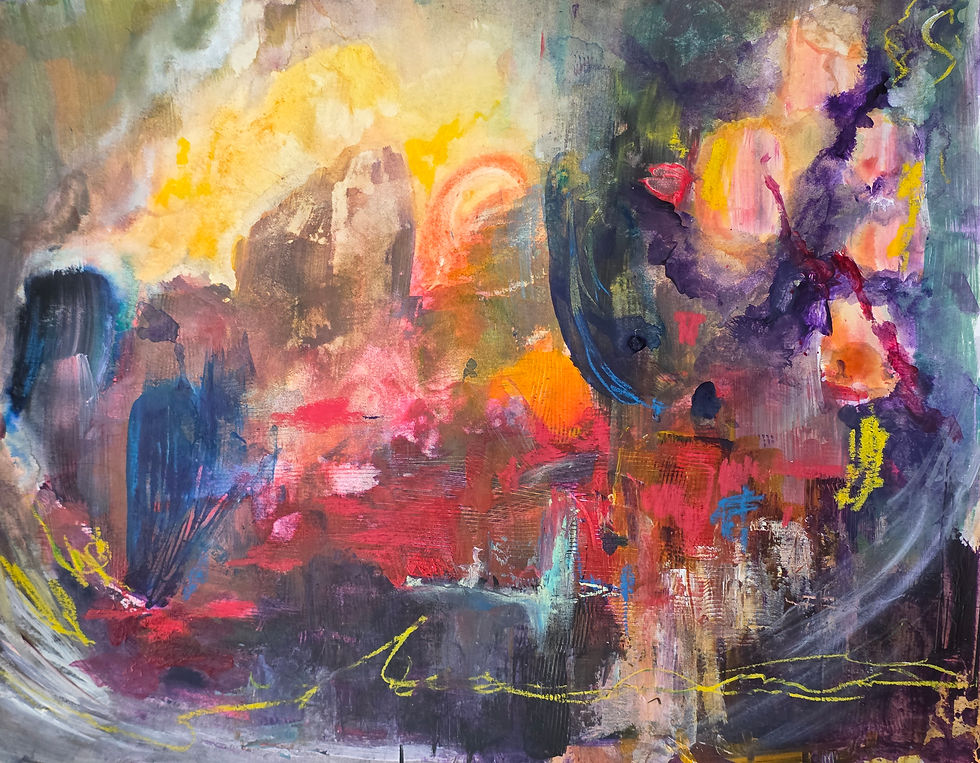
Today they talked about value. This time I tried implementing what Nick taught. One piece of advice was to just paint, see what you like, and then copy, enlarge, or expand those elements. I liked the area where the watercolors mixed, and some of the strokes to the right with the yellow-pink brushwork. I also liked the red area made with a plastic knife — it had an interesting texture. So I kept those areas and tried to emphasize them.
Day 4
Today it was about color. I really liked all the example artworks shown so far — they've opened up my world and helped me understand a few things better. I had a feeling in my mind of red and some green, not sure why, so I played around with those two colors.
Admittedly I was being a little careful trying to implement what Nick taught. I really liked the red and wanted to emphasize it. As I was painting and getting a feel for what I liked, I added some white — and suddenly it looked like a waterfall, with the red feeling like a building. I just went with it, adding elements as I went.
I wasn't sure about the green; it felt too dark and dull, but I didn't want it to overpower the red. Acrylics dry a bit dull, so the green ended up darker than I would have liked. I used green for contrast against the red, but I'm not sure what I could have done to lift this painting further. Still, I like how it turned out — it's one of my favorite pieces.

Day 5
I would love to join their full program, but for now I want to explore on my own — so I decided to take what I learned that day and run with it. The idea that stuck with me was that you need to take risks in art, otherwise you won't discover yourself. So I took a risk. I used alcohol markers and dropped isopropyl alcohol on them. I initially wanted to blend the colors using the alcohol, but while I wasn't able to blend them the way I hoped, it created an interesting texture that reminded me of tie-dye shirts. And perhaps because I had been looking at dresses that day, my mind went to dressing these shapes like figures in skirts. Interestingly, it turned out to be a much brighter piece compared to the day before.
The alcohol changes the feel of the paper in an interesting way — similar to how watercolor behaves over oil pastels, but with its own distinct quality. Usually with watercolors you can lift or wipe away some of the paint, but here I couldn't do that. Oil pastels also don't show up strongly on their own — they usually only make their presence known once blended.
This is not something I would ever have thought of making.

And with that the workshop concluded. Looking back, this workshop taught me more than just technique — it taught me to listen to my own voice and trust my own taste, instead of trying to fit into someone else's idea of what art should look like. That, I think, is the most valuable thing any workshop can teach you.


Comments